Handrail Emergency Lighting
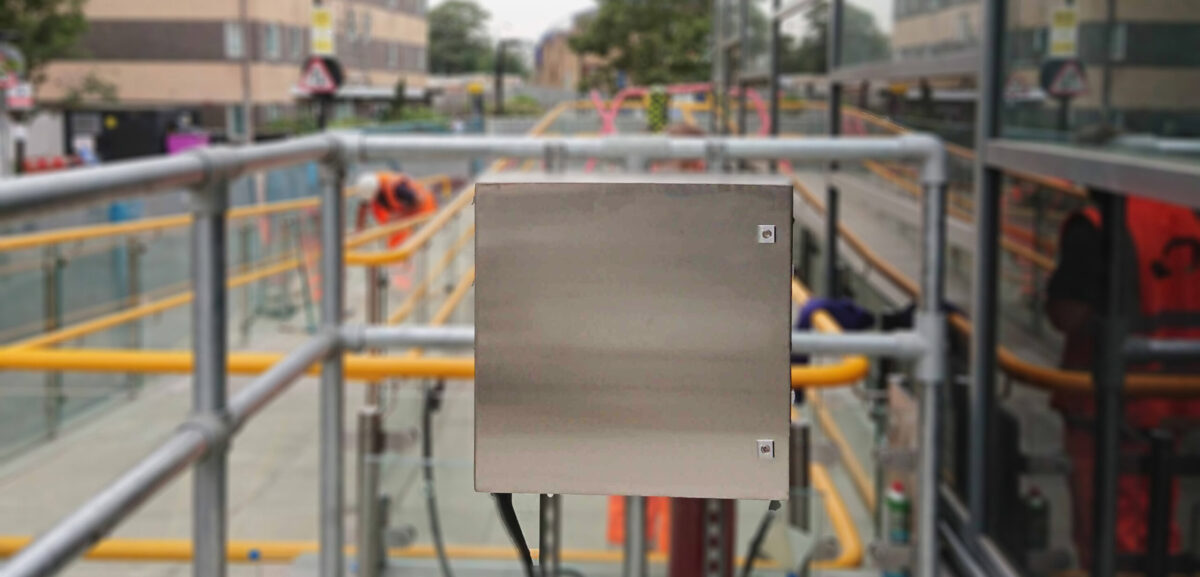
Handrail Emergency Lighting.
Illuminated Handrails are perfect for illuminating exit routes in the case of emergency and power failure. Lighting the path of tread, highlighting obstacles and surface variations.
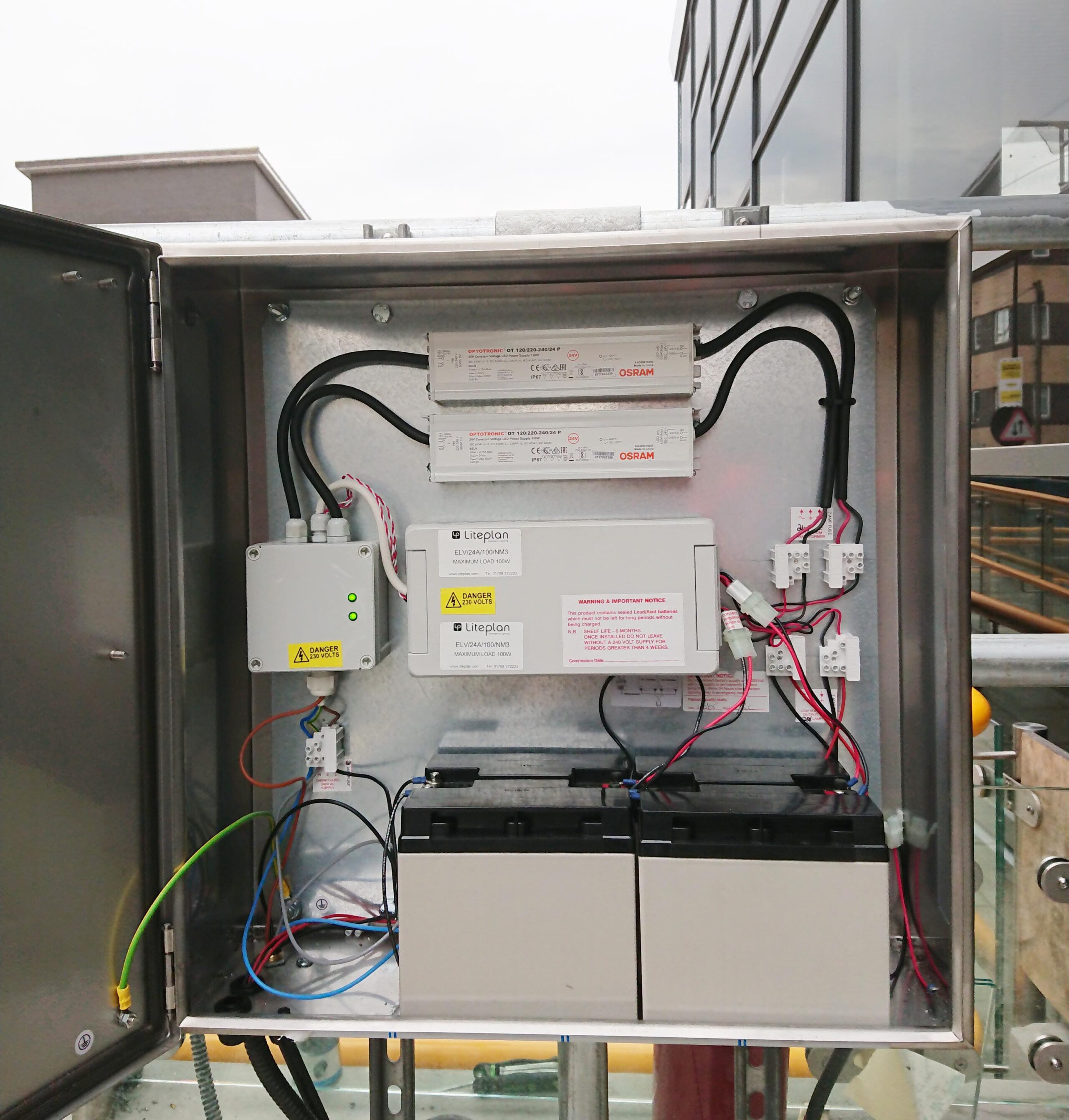
We provide autonomous 3hour Maintained and Non-Maintained Battery backup systems, built into watertight enclosures. Please contact us to discuss your requirements
What is Handrail Emergency Lighting?
Quite simply, in the event of power interruption the emergency lighting circuit activates automatically in order to provide a safe exit passage. Emergency lighting is not just about a catastrophic event. More often than not it is installed in public spaces and buildings to operate in the event of mains power failure.
Different Types of Handrail Emergency Lighting and Back-Up Systems
There are different two types of Emergency Lighting operation:
Non- Maintained. In normal operation, the designated Emergency lights are switched off
Maintained. Emergency lights operate with the lighting circuit, remain on when the power is cut.
Back up Systems:
Battery Conversion. Stand-alone batteries with charger fitted into an enclosure that includes the LED Driver
Uninterrupted Power Supply (UPS). A remote Central Battery System provides power to all Emergency light fittings in a building or space
Generator. Provides AC power to the Emergency lighting circuit and others. Typically used in Hospitals
How does the Handrail Emergency Lighting System know when to activate?
In order to sense a power failure, most systems feature an additional AC connection, a “permanent live”, connected directly to the Distribution Board, independent of any switch. Immediately the permanent live has zero volts the system kicks in.
Integrating Emergency back up into Constant Current and Constant Voltage Circuits
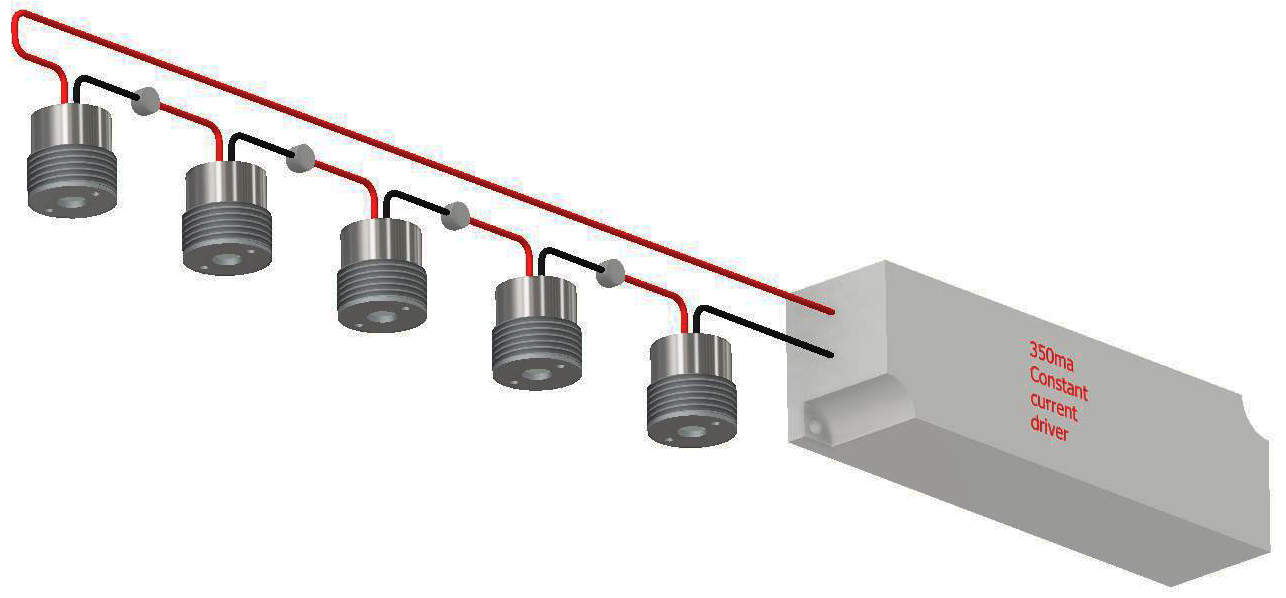
Constant Current Series Circuit
Constant Current circuits are the easiest to install and are perfect for Wooden Handrails, with fewer parts and smaller supply wires. However, the Projectors are wired in series, which means that in the (rare) event of a single failure all light will be extinguished. Therefore we do not recommend Constant Current circuits for critical Emergency installations.
Constant Voltage Parallel and Series /Parallel 24volt Dc Circuit
24volt Dc Series /Parallel
By far, the most common circuit installed is the Series /Parallel. Altogether, easier and with fewer components, more cost-effective.
Connect Dc-Dc converters to the 24v wires using Run and Tape Wire Splices in order to create a parallel connection. Then connect the Projectors in series (positive to negative) in quantities of 1-6.
In this case, if one lamp fails, only the others of this individual circuit will be extinguished.
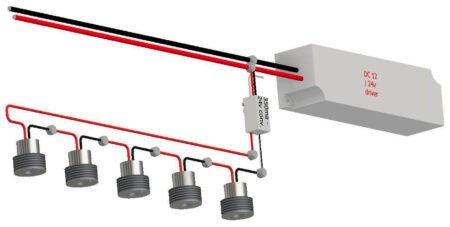
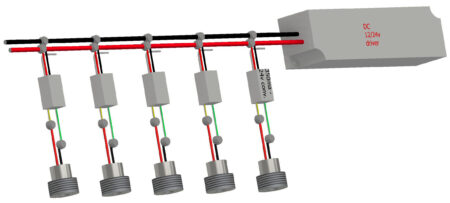
24volt Dc Parallel
Use for installations where the operation of each lamp is critical. In order to ensure this, connect Projectors to the supply through a dedicated Dc-Dc converter, In this case, one lamp failure will not affect the others.
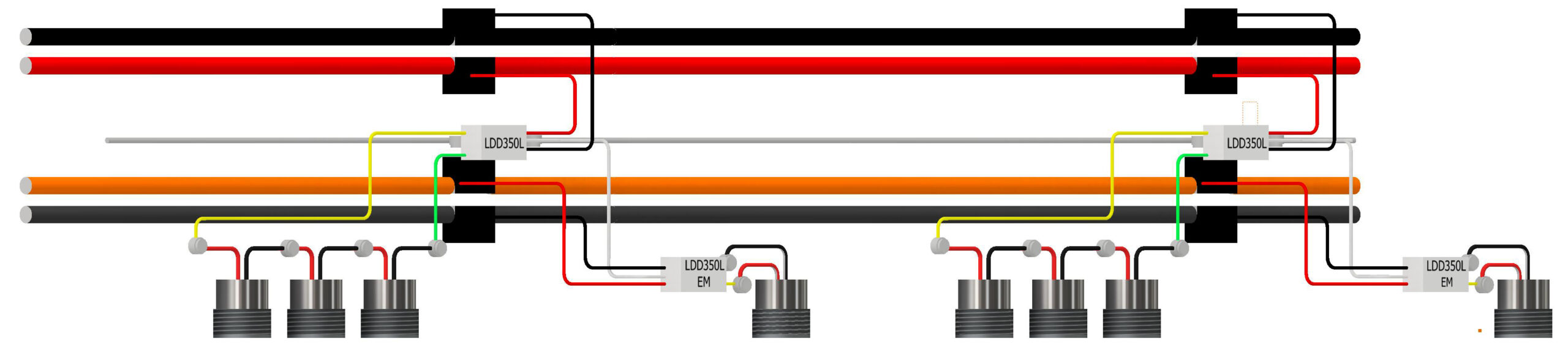
Handrail Emergency Lighting Twin Circuit
Emergency lighting regulations call for illuminance at a much lower intensity so spacing can be increased. As a result, this circuit has every fourth Projector connected to a dedicated Emergency driver / central or autonomous battery backup.