
LED Handrail Retrofit Cricklepit Bridge Exeter

A Case Study

LED Handrail Retrofit to Cricklepit Bridge Exeter.
Originally constructed in 1988, the bridge is reinforced concrete with cast iron balustrading. The handrail is a 100x50mm box section in mild steel with a nominal wall thickness of 3mm.
Dimensions, length 70metres, width between handrails 4metres, balustrade section 2metres nominal
Original lighting:
Four floodlights mounted at a high level on the upper crossbeams of the bridge.
Effect:
High levels of glare with little illumination on the bridge deck and very low uniformity.
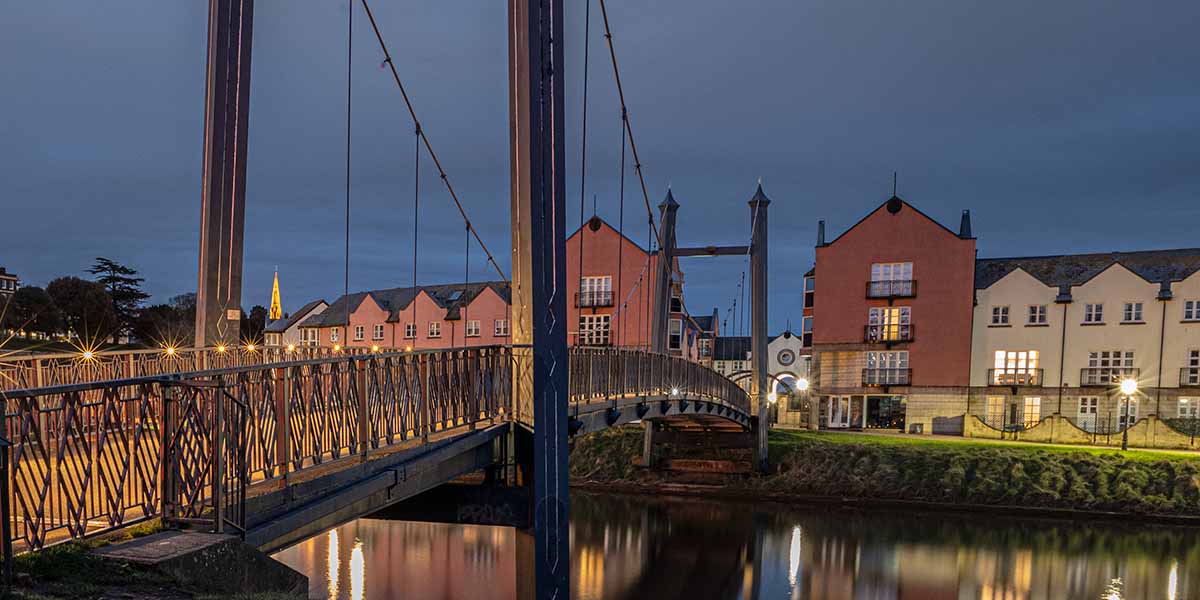
Our installation partner, LTP Integration, brought this project to us and carried out the work.
Upgrade
The brief was to install lighting into the handrail in order to achieve an illumination performance in line with current guidelines in intensity and uniformity.
Solution
We work as a team with our Installation Partner, LTP, on the design. Lighting standard P2 was adopted as the bridge is a busy thoroughfare for pedestrians and cyclists even after dark. This calls for an average illumination of 10 lux and uniformity of 20%.
Ideally, the projector would have been installed on the underside of the handrail, but only the front vertical face was available.
Photometric Design
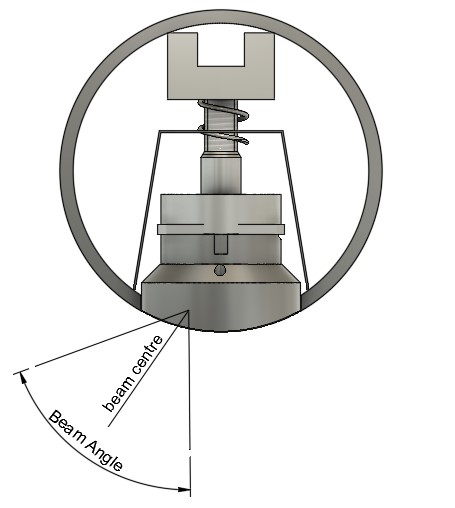
Software simulation determined that a 70-degree lens set 35 degrees below the horizontal would achieve 14 lux and a respectable light dispersion of 53%. Spacing at 2-metre centres, the mid-point of each balustrade section. Our Flat Face Quicksert Asymmetric was the ideal housing.
Marine Grade Stainless Steel and Anodic Corrosion
Two dissimilar metals in contact will cause Anodic Corrosion to occur, especially in an outdoor environment.
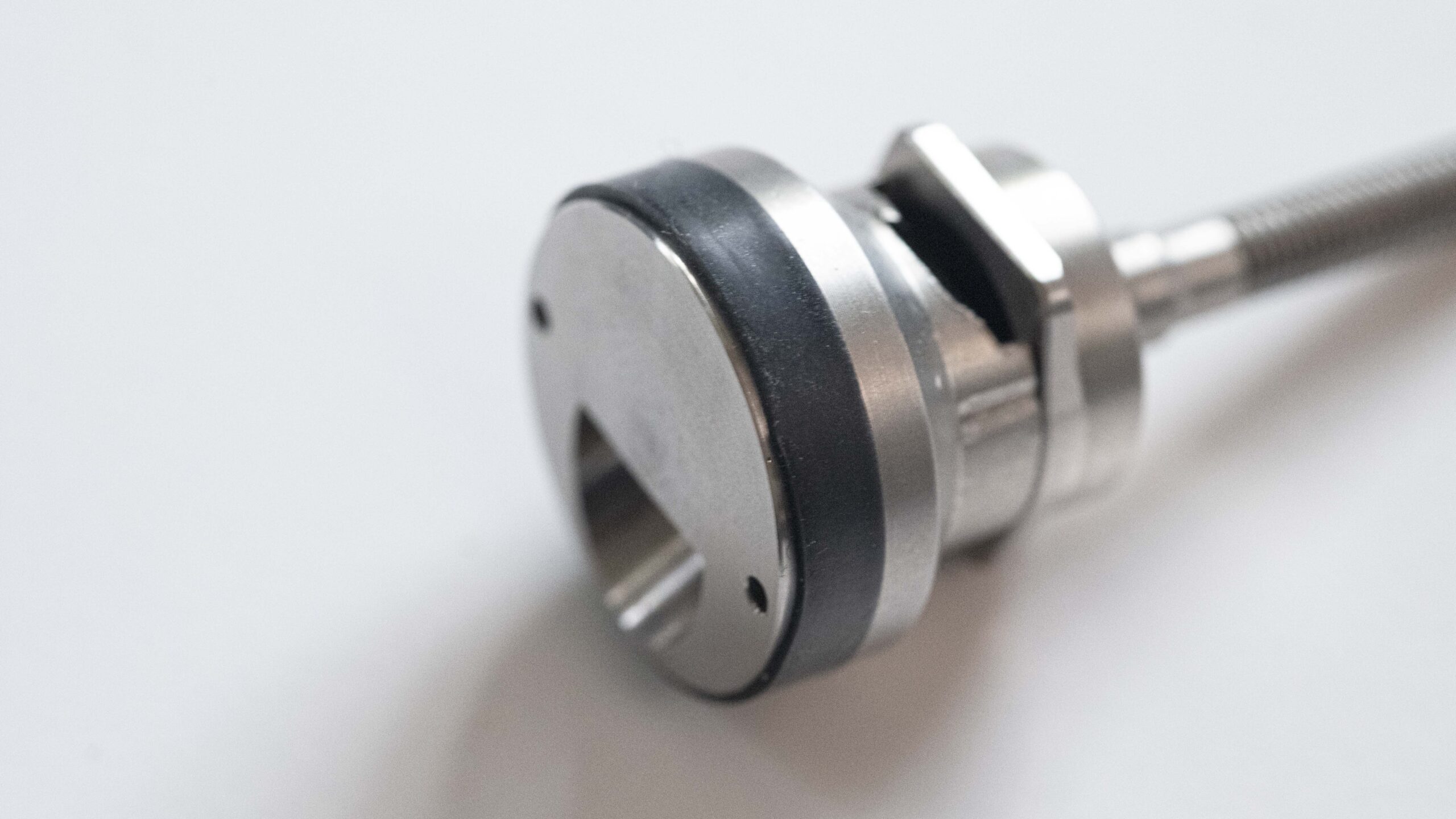
The body and retention components of Quicksert Asymmetric are made in316 (A4) Stainless Steel. The Anodic difference with Mild Steel is around 0.33v.
To overcome this problem, the Quicksert body was increased to 24.8mm diameter, enabling the addition of a continuous 5mm wide EPDM gasket wide. In addition, the retention back nut was coated with a rubberoid solution effectively isolating the installed product from the handrail.
Quicksert Asymmetric
Quicksert Asymmetric features our Instant Fit retention system
It was discovered that the wall thickness varied along the bridge. Although Quicksert was delivered at a pre-determined depth the design allows for adjustment on site ensuring that a flush finish was achieved for all fittings.
All of our products are machined from a solid billet of metal, not cast, this means that any modifications at the design stage or installation can be achieved quickly and cheaply.
LED Handrail Retrofit Cricklepit Bridge Exeter - Drilling and Installation

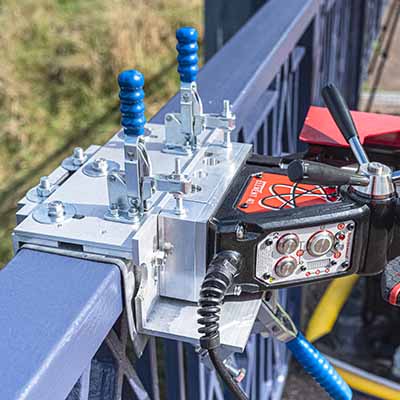

New Drilling Jig Design
A new drilling jig was developed to accommodate the box section handrail. Made in lightweight Aluminium and featuring numerous clamping positions, the jig is adjustable to ensure the correct positioning and to apply adequate clamping moment.
Attachment of the modified Rotabroach element 40 drill is by our universal alignment base. This allows for rapid change of left to right orientation and is compatible with our drilling jig for round handrails.
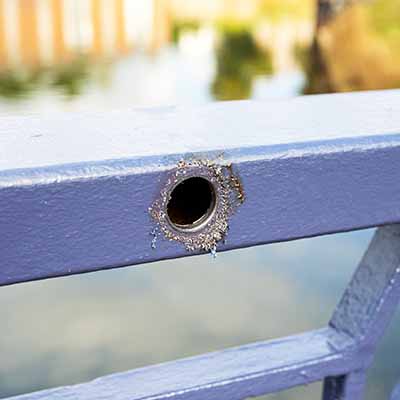
A single 25mm TCT cutter was used for the 74 Quicksert apertures, plus 40 holes to allow for cabling between the closed handrail sections.
Setup and drilling time
LTP supplied two men to site. 110v power was provided from a portable generator; the small work area was screened from the public, allowing the bridge to remain open during the operation.
Setup and drilling took around 5 minutes per hole, including deburring. After painting a protective plastic cap was inserted. Quicksert Asymmetric requires no other mechanical work, fitting directly into the finished hole.

Feedback
"The drilling system worked seamlessly, creating the precision apertures required to accommodate the LED projectors.
The installation took less than two weeks, from drilling the first hole on day one to turning on the new lighting system on day 11.
The finished results speak for themselves, with the new lighting system attracting praise from the client, local businesses, and the public.
Introducing this unique, new, and cost-effective process presents the ability to integrate energy-saving LED lighting to British Standard lighting levels in public realm areas and regeneration schemes.
Previously, it was considered too costly and disruptive to replace with new steelwork systems, but this solution means that it is no longer necessary."
Keith Elms LTP
https://www.ltpintegration.com/
“ECC commissioned LTP Integration and Products to install lighting on one of Exeter’s iconic bridges to which we are delighted with the outcome. From awarding the project to completion the LTP team have demonstrated good communication whilst delivering a high standard of workmanship."
Dan Trott
Capital Projects Engineer, Exeter City Council